Coinfest Asia and Indonesia Financial Authority (OJK) Break Down Key Challenges Shaping Indonesia’s Digital Asset Future
Dialogue highlights regulatory infrastructure as a key challenge to institutional readiness for stablecoin adoption and asset tokenisation.
By Anisa Giovanny
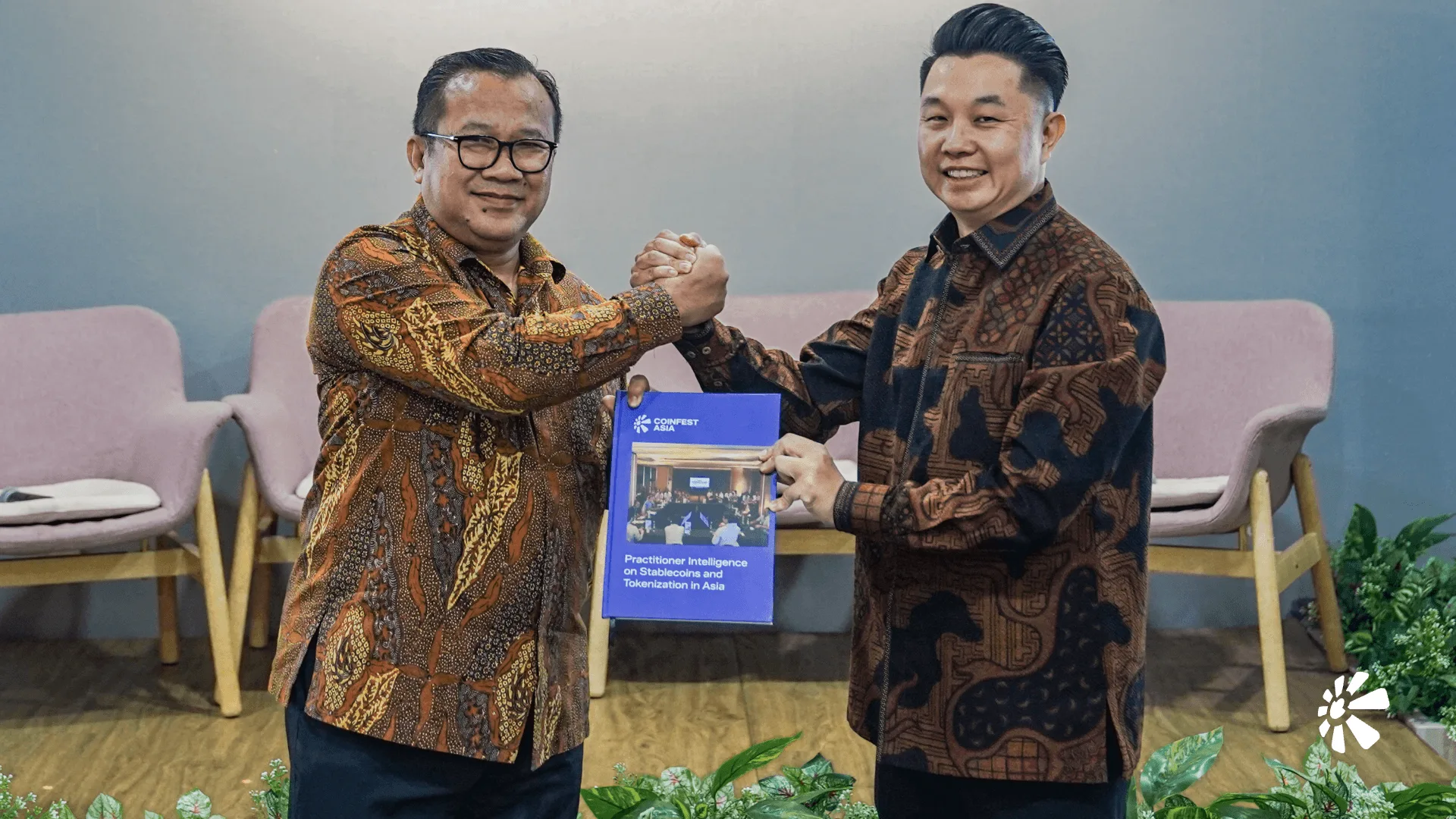
JAKARTA, Indonesia, November 17, 2026 — Coinfest Asia and Indonesia’s Financial Services Authority (OJK) examined key challenges and the strategic direction of digital asset development in Indonesia during the Industry Intelligence: Key Findings & Regulator Dialogue on Indonesia’s Digital Assets forum, held at the OJK Innovation Centre in Jakarta on November 17, 2026. The dialogue highlighted tokenholder rights and protections, secondary market liquidity, and institutional readiness for stablecoin adoption and asset tokenisation.
During the meeting, Coinfest Asia presented its report, Practitioner Intelligence on Stablecoins and Tokenization in Asia, which consolidates industry practitioners’ perspectives on the opportunities, risks, and implementation challenges surrounding digital assets across Asian markets. The report served as a basis for discussions connecting industry experience with the development of Indonesia’s digital asset ecosystem.
“We have consolidated practitioners’ perspectives on the requirements for stablecoin and tokenisation development, ranging from tokenholder protection and secondary market liquidity to institutional readiness. Through our dialogue with OJK, we aim to bring real-world industry needs to regulators, helping ensure that policy development takes into account the practical challenges of implementation,” said Dhila Rizqia, Co-Head of Coinfest Asia.
Asset Protection, Liquidity, and Institutional Readiness Take Centre Stage
On tokenisation, the report identifies three key requirements for broader institutional adoption: clarity on tokenholder rights and protection of underlying assets in the event of issuer insolvency, secondary market liquidity, and the development of distribution channels and investor access.
The report also examines tokenisation opportunities across six asset classes: gold, money market funds, real estate, private credit or SME financing, equities or equity indices, and intellectual property royalties. Based on practitioners’ assessments, gold and money market funds emerged as relatively near-term opportunities for tokenisation in Asia, although stronger distribution channels and supporting infrastructure remain necessary.
For stablecoin adoption, the report outlines eight areas of internal institutional readiness: due diligence on issuers’ reserves, issuer assessment and selection, compliance monitoring, wallet and custody governance, accounting treatment, settlement processes, redemption procedures, and board-level approvals.
OJK Recognises Industry Input as Valuable for Digital Asset Ecosystem Development
Adi Budiarso, Chief Executive of the Supervision of Financial Sector Technological Innovation, Digital Financial Assets and Crypto Assets at OJK, said the report presented by Coinfest Asia provides valuable input into understanding the needs and dynamics of the digital financial asset industry.
“For us, this report provides valuable input into understanding the needs and dynamics of the industry,” said Budiarso.
During the dialogue, Budiarso also emphasised the importance of translating industry discussions into concrete actions to strengthen the ecosystem and increase innovation’s contribution to the national economy. He noted that developing the digital financial asset industry requires collaboration among government, industry participants, innovators, academics, media, and communities.
“Indonesia has significant opportunities to play a more active role in the global transformation of digital finance. However, we must recognise that we cannot work alone,” he said.
Beyond collaboration, Budiarso highlighted the importance of balancing industry growth with ecosystem readiness. He outlined three priorities that should guide the development of the digital financial asset ecosystem: improving public literacy, strengthening the industry, and maintaining stability.
“Our vision must encompass at least these three elements: literacy, industry, and stability,” said Budiarso.
Budiarso also expressed hope that the findings and input presented during the meeting would lead to concrete follow-up actions. Looking ahead, OJK also emphasised the importance of measuring progress in financial literacy, financial inclusion, and governance to ensure that industry development initiatives deliver tangible results.
Through its dialogue with OJK, Coinfest Asia aims to bring practitioners’ perspectives into discussions on the future direction of digital asset development in Indonesia. The meeting forms part of broader efforts to strengthen communication among industry participants, financial institutions, and regulators, enabling more structured discussions on the requirements and challenges of implementing stablecoins and tokenisation.
The Practitioner Intelligence on Stablecoins and Tokenization in Asia report was developed from four closed-door discussions involving practitioners and industry leaders from across Asian markets during the Institutional Summit in Bali on August 21, 2026, with support from ICEx Group.
The full report can be accessed here, offering a reference for institutions and stakeholders seeking to understand the opportunities, risks, and readiness requirements associated with stablecoin and tokenization implementation.
About Coinfest Asia
Coinfest Asia is the world’s largest crypto festival and an end-to-end growth partner for the crypto and Web3 industry, providing integrated solutions across three core pillars: Intelligence, Marketing, and Experiences.
Based in Asia with a global reach, Coinfest Asia connects industry participants, businesses, and communities to unlock collaboration opportunities, support market expansion, and advance the real-world adoption of crypto and Web3 technologies.